Does UK Small-Scale Radio Licensing Need Rethinking?

A recent report by radio consultant David Lloyd to Ofcom says that the UK government should rethink its approach to community and small-scale radio.

In an ideal world it would be nice for us all to have a community radio station with news and information about what is going on in and around the area. However, when you are talking about areas within say a London Borough, my own area – Colindale – has a population of only 17,098 and the nearest bigger area is Hendon with just 18,472 people. The whole Borough of Barnet has a population of 379,691.

Without delving into heaps of statistics, one has to work out what percentage of the population will listen to the radio at all and then how many of those will listen to ‘our’ station.

Would there be sufficient content to make it “local/community” without resorting to playing the Top40? Would it be funded by advertising or by one or more people with deep pockets?

I suppose the cheapest way of providing the service is ‘back-bedroom’ and hiring air-space on something like Shoutcast.

However, time and effort is involved because the local stories would need to be researched and written up. Would presenters want to be paid or would it be voluntary for the love of the community?

Incidentally, we used to have two local newspapers in the Borough. One folded up completely and the other has amalgamated all its titles across the Borough into one. Even after that, they still use stories from other Boroughs — of no great interest for those wanting local news.

Back in the 1960s and 1970s, when we were campaigning with the Campaign For Independent Broadcasting for an end to monopoly radio in the UK, we strongly believed that the only criteria for the limitation on the number of radio stations in any region or locality should be technical feasibility and commercial viability. I think the same still holds today.
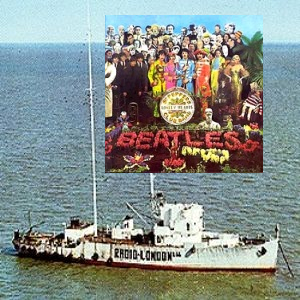
Remembering The Beatles Sgt Pepper’s World Premiere Broadcast 12th May 1967

The Beatles’ 8th album, “Sergeant Pepper’s Lonely Hearts Club Band”, became a huge seller, spending 15 weeks at number 1 in the USA in 1967 and 27 weeks at number 1 in the UK Albums Chart. Over more than 50 years since its release it has continued to sell well and by 2011 had sold more than 32 million copies worldwide, making it one of the best-selling albums of all time.

Offshore Radio London - Beatles Sgt Pepper

Radio London broadcasting from m/v Galaxy

The Sgt. Pepper LP was originally released on 2nd June 1967 in the USA but in the UK the release was brought forward to 26th May because of huge additional demand caused by repeated plays over offshore Radio London and subsequently by Radio Caroline and other offshore pirate radio stations … publicity which, at the time, the Beatles’ record company, E.M.I. considered undesirable.

Just how pirate Radio London managed to lay their hands on a tape of this album several weeks before its release is revealed by Radio London’s then Programme Director, Alan Keen, in a recording I’ve assembled from several available sources.

The album was aired for the very first time by Radio London between 5 and 6.09 p.m. on Friday, 12th May 1967 but, to my knowledge, no complete recording of the broadcast exists. Our recording of all available parts of this programme is available for download on our radio archive page (scroll down the page), and a shorter version is also available online, including a commentary by Alan Keen, as well as the voices of Big-L DJs Keith Skues, John Peel, Ed Stewart, Pete Drummond and Mark Roman.

You can read more about this historic Radio London /Beatles broadcast on the Radio London website as well as more information about the Sergeant Pepper’s Lonely Hearts Club Band album.

Thanks to East Anglian Productions, Hans Knot, Azanorak, Mixing Mastering Online and Paul Osborn for making parts of this recording available.

Important Request!
As you can hear when you listen to this recording, it is incomplete and “work in progress”, so …  If you, or someone you know, has an unscoped recording of the first 23 minutes of this program (i.e. from 5.00 pm or earlier to 5.23 p.m. 12th May 1967) please please contact us.

Can’t find what you are looking for?
Generic selectors
Exact matches only
Search in title
Search in content
Post Type Selectors
post